Making unsafe configurations impossible, and the rest reviewable

Beacon alerts businesses when something changes about a person or company they care about. I designed a maker-checker approval flow so that its compliance-critical product settings are checked before they go live, without interrupting the business.

Role
Product manager and designer
Industry
B2B fintech
Product
Credit monitoring admin portal
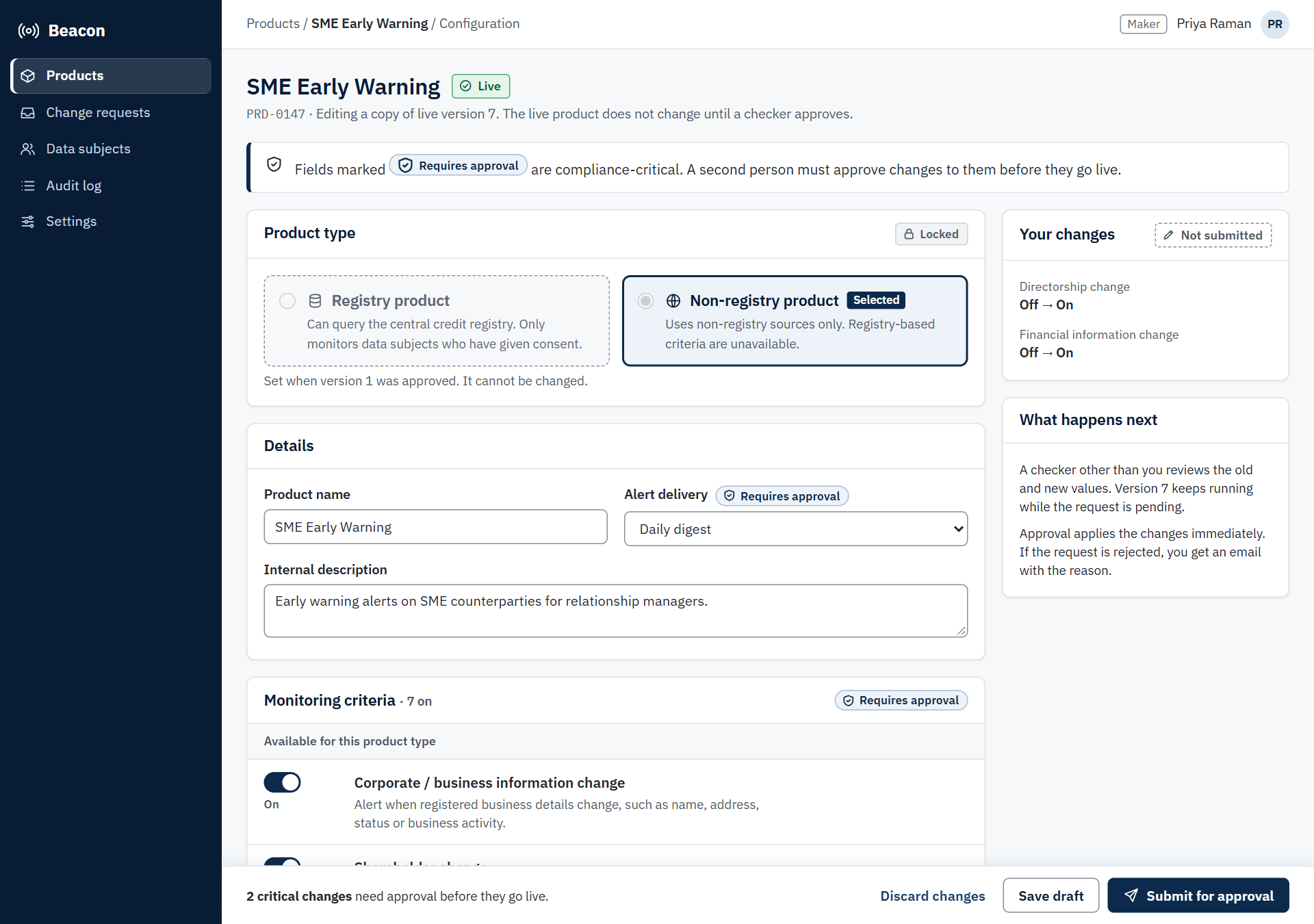
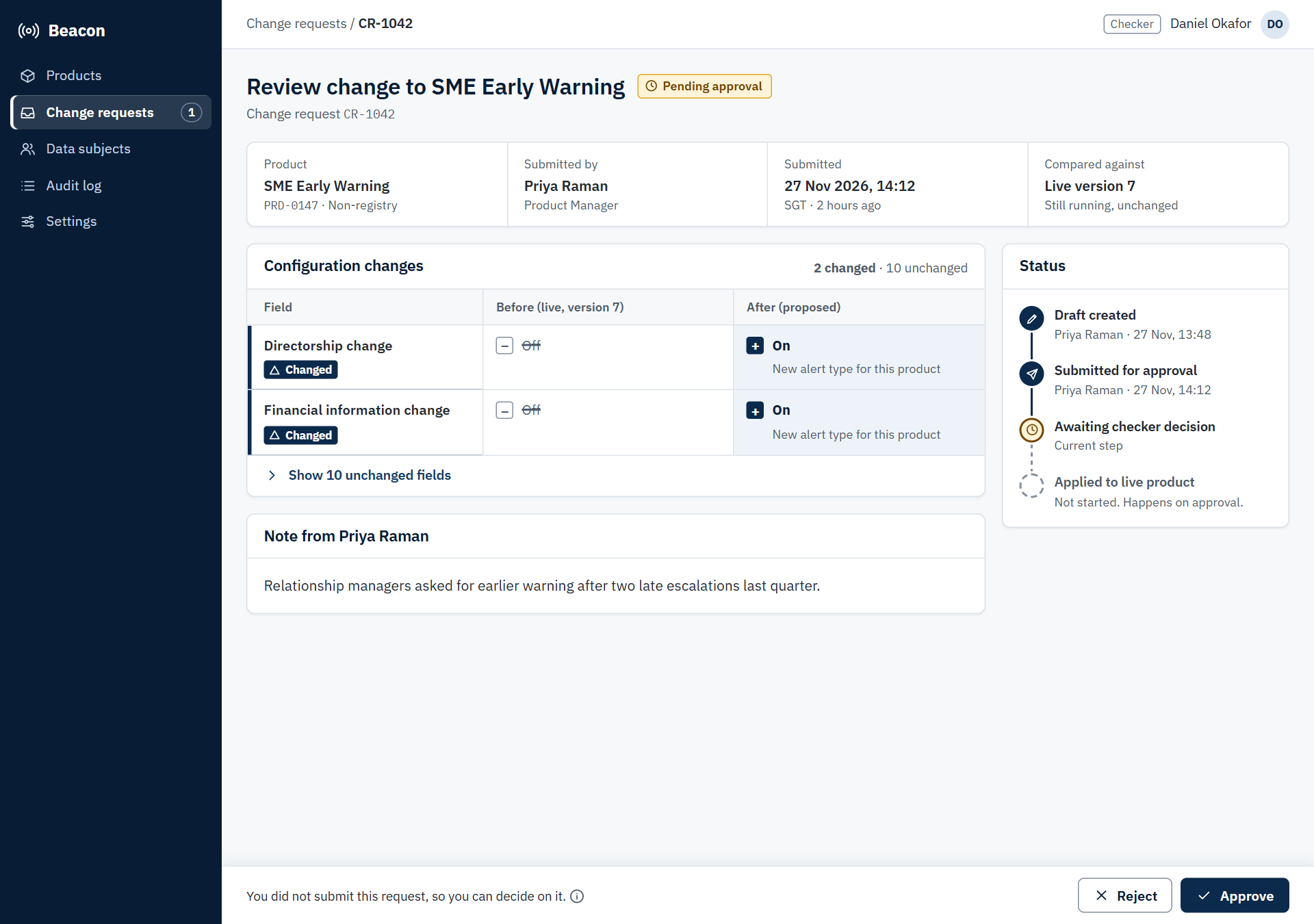
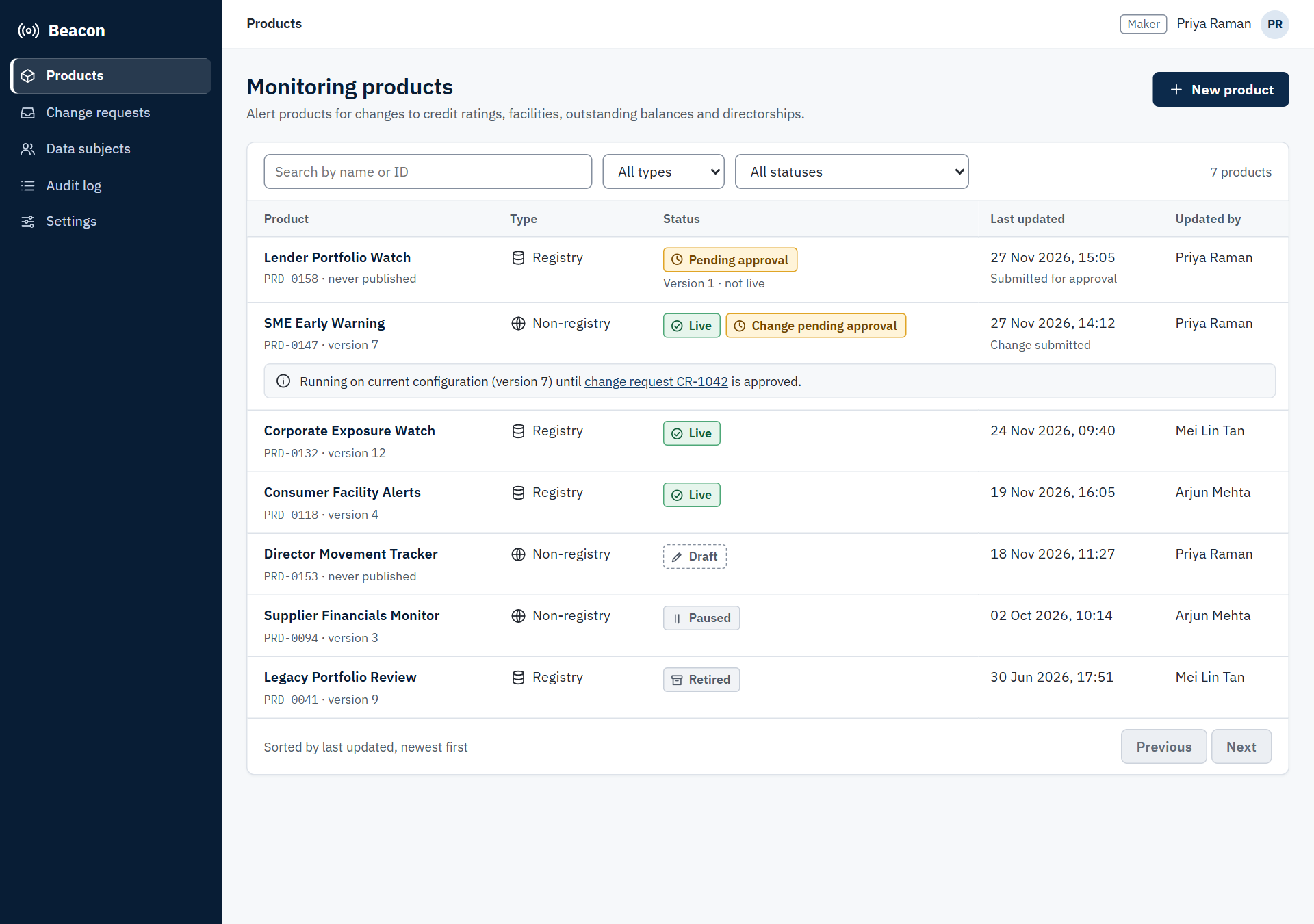
Configuration editor with product type locked and critical fields marked as requiring approval Checker review screen with before and after values side by side Product list showing a live product with a change pending approval

Summary

Product managers set up each monitoring product in a back-office admin portal, choosing what it watches: company information, directors, shareholders, legal cases, credit ratings, facilities, balances and more.

Some of those criteria pull data from a regulated central credit registry. That carries a cost and a legal condition: the platform may only query the registry for data subjects who have given consent. I designed an approval module that makes sure these configurations are set up correctly before they ever go live.

One wrong setting, a compliance breach

Critical product configurations were edited directly in the admin portal. I spotted the risk early: nothing stopped a setup that looked valid but wasn’t.

A valid-looking setup that breaks consent

A product meant for data subjects without consent could be configured with registry-based criteria. If it went live, the platform would query the registry without consent: a compliance problem and an avoidable cost.
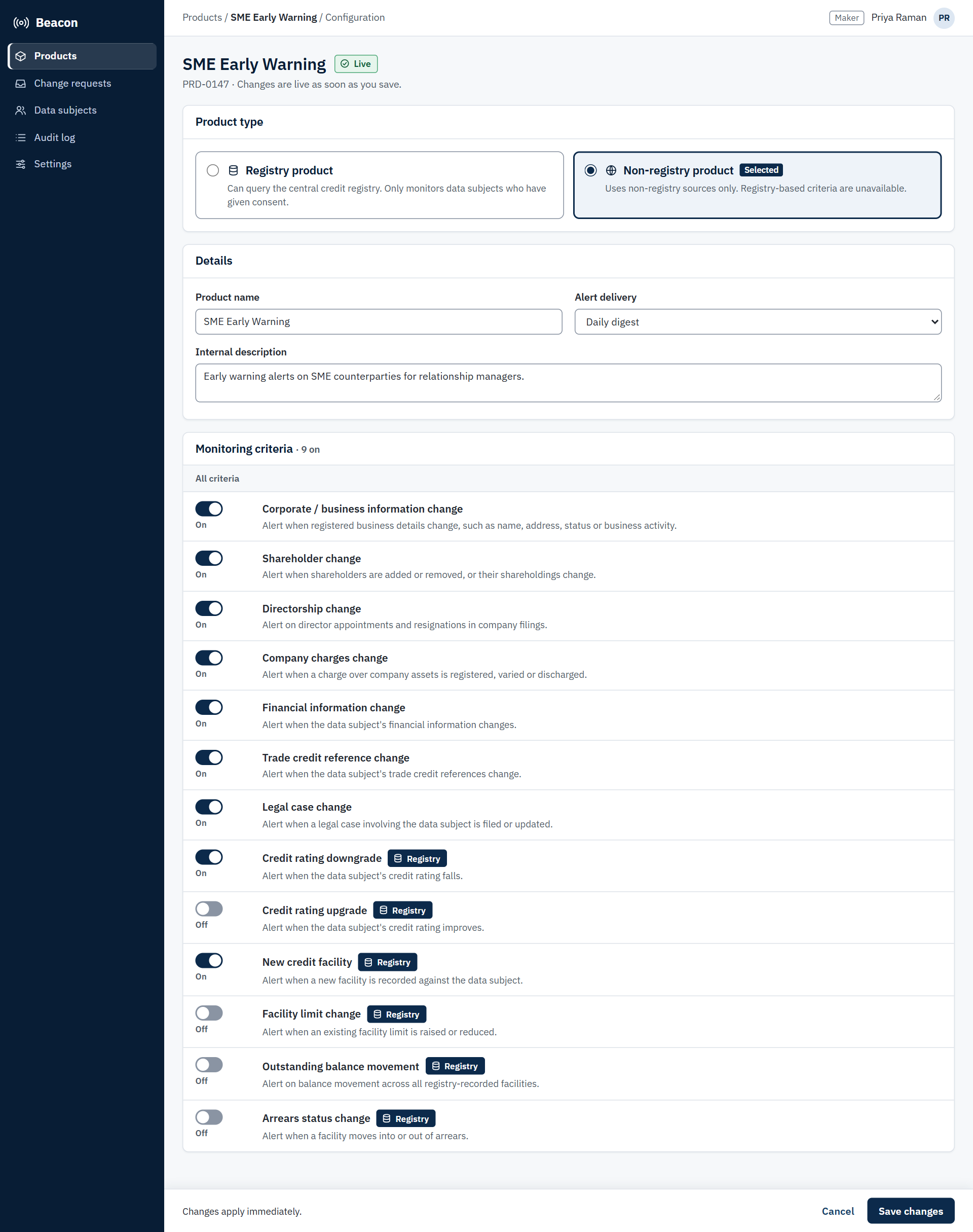
Reconstruction of the old editor: a non-registry product with registry criteria switched on

Before, reconstructed: a non-registry product with registry criteria switched on.
One person, straight to live

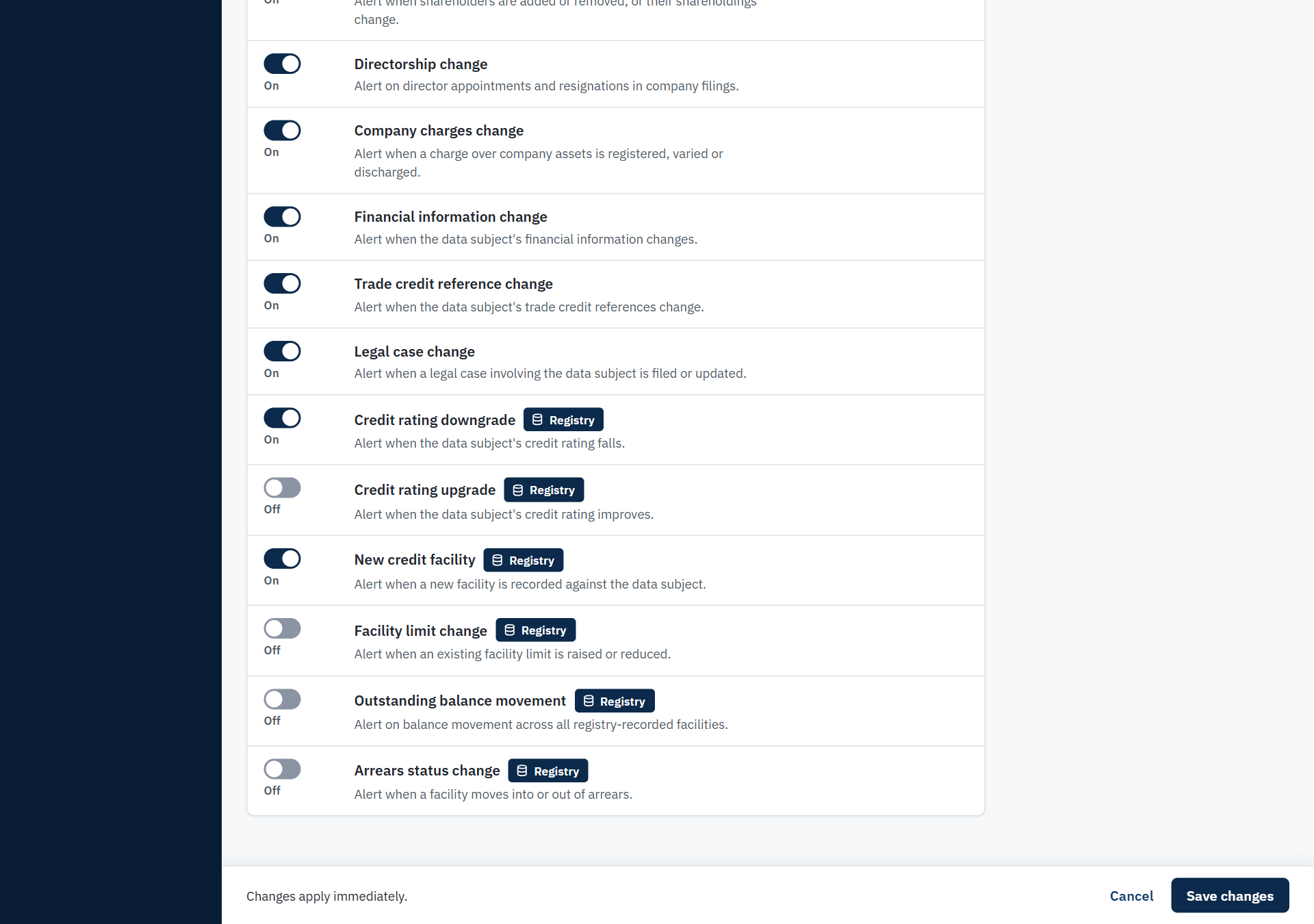
There was no second pair of eyes. A single mistaken edit by one person was all it would take, and nothing in the flow would show that an unsafe setup had been saved.

Reconstruction of the old editor with a Save changes button that applies immediately
Live. No one else looked.

Before, reconstructed: saving and going live were the same action.

Review couldn’t cost the business

Customers were being monitored under live configurations, so a review couldn’t pause or alter them. It also had to be quick to read: an approval step that slows people down gets rubber-stamped.

A live product under a blocking approval

MonitoringPaused for reviewBack on
Edit madeReview done

The failure to design out: safety that interrupts the service.

Design goals

Four rules the flow had to meet.

Make the unsafe setup impossible

Where a rule can be enforced by the system, enforce it, rather than relying on someone to remember.

Keep a human as the last line of defence

Automated rules catch known mistakes. A checker catches the ones nobody anticipated.

Never interrupt live business

Reviewing a change must not pause or alter any product already in use.

Make review fast and unambiguous

A checker should see exactly what changed and decide with confidence.

Decision 01

Separate the maker from the checker

A change to a critical setting is submitted by one person and approved by another before it takes effect.

The problem

A single person could change a critical setting and have it take effect immediately.

The decision

The maker submits critical changes and a checker must approve them. Routine, non-critical fields stay directly editable, so approval only appears where the risk is.

Why it mattered

Separating duties is the standard control for high-risk changes. Applying it to every field would have turned approvals into noise.

  1. Maker edits
  2. Submits
  3. Checker reviews
  4. Approved: applies now
  5. Rejected: maker emailed
  6. Edit and resubmit
Decision 02

Let the system block what should never be allowed

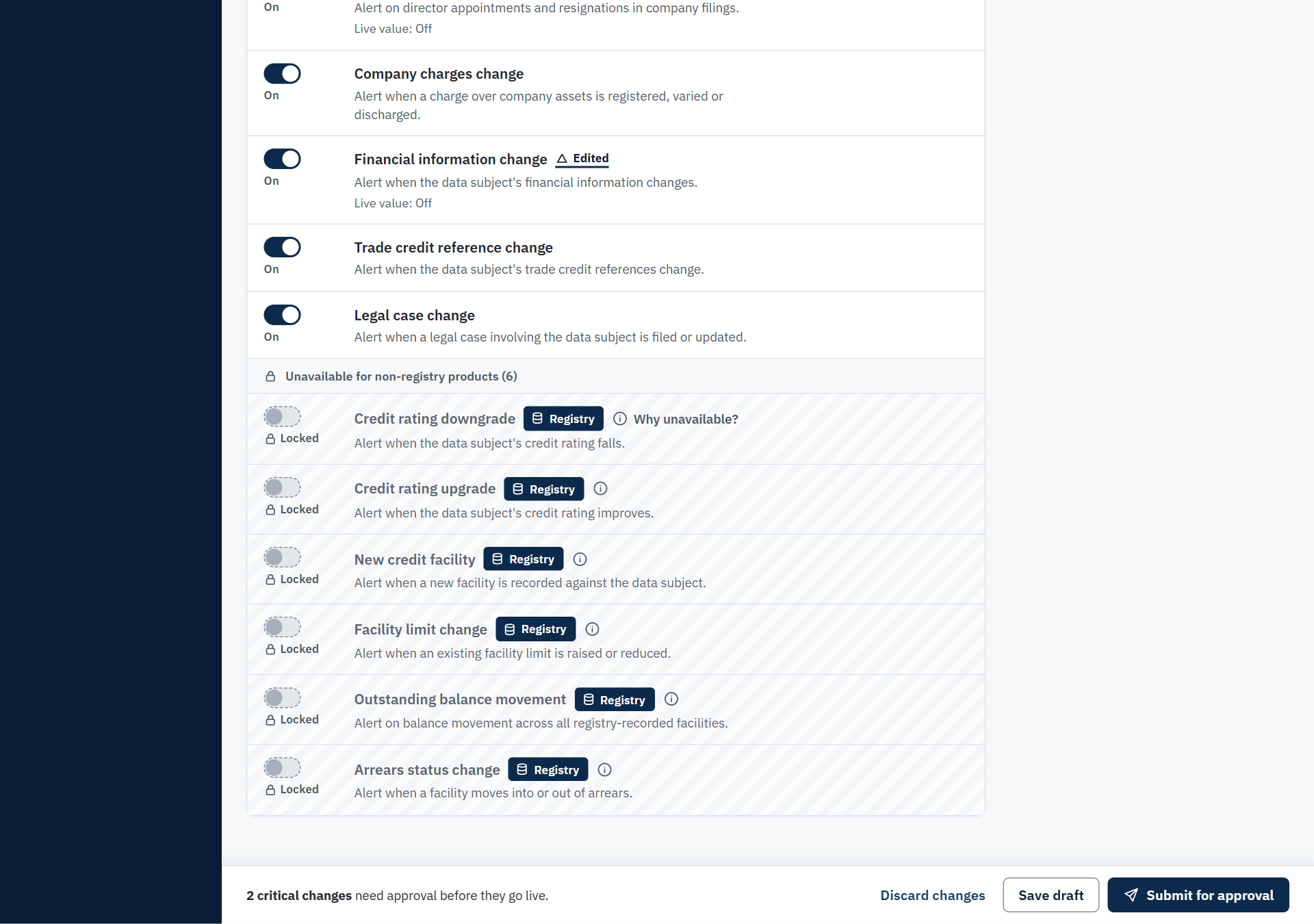
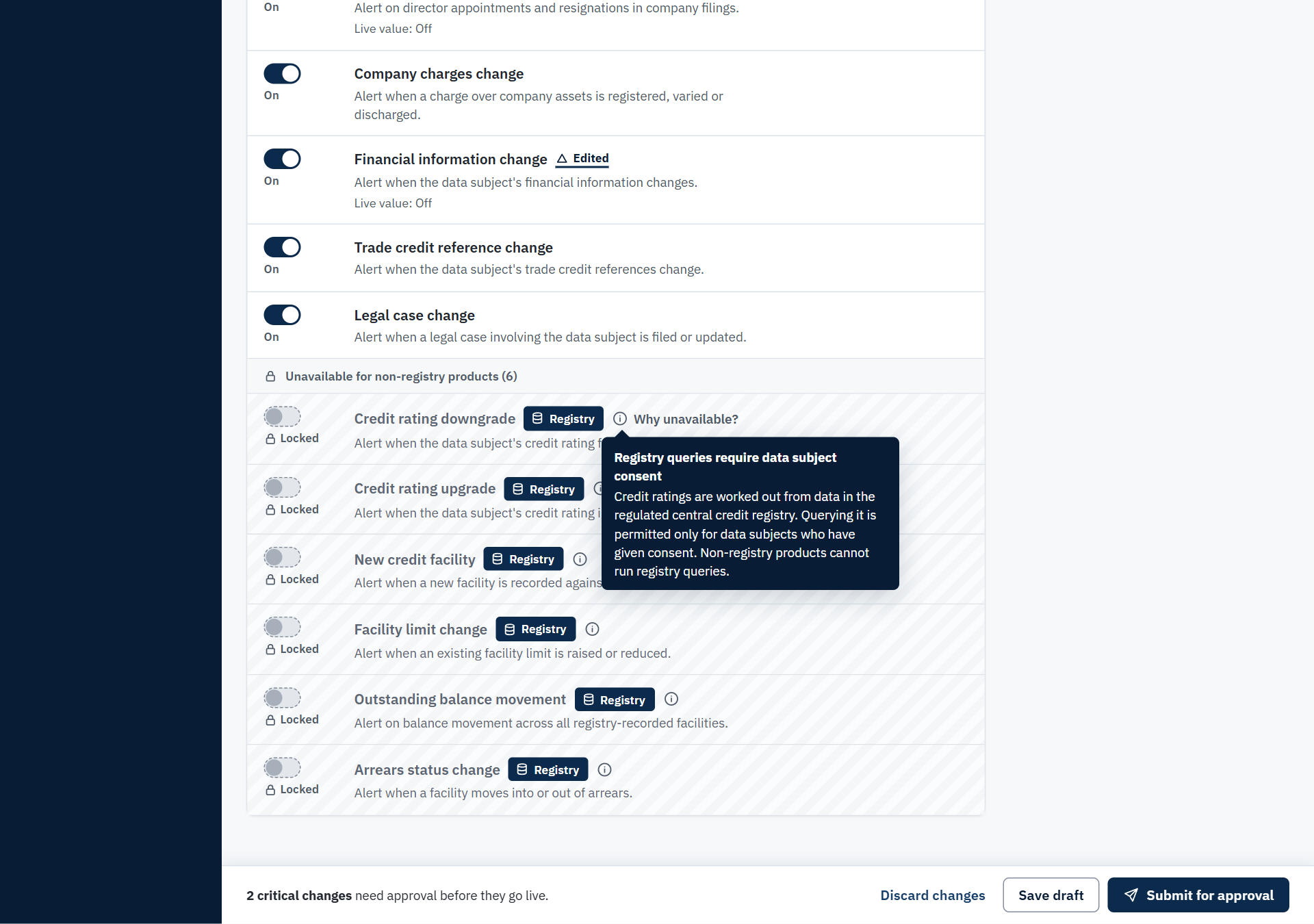
Every product is either a registry product or a non-registry one. On a non-registry product, registry criteria can’t be switched on at all.

Before: non-registry product6 open
Reconstruction of the old editor: all six registry criteria can be switched on
After: non-registry product0 open
Redesigned editor: all six registry criteria are locked

Credit ratings are in the locked group too: producing them means querying the registry. Before, reconstructed.

The problem

Relying on a reviewer to spot a registry criterion on a product that must not use the registry depends on attention at exactly the wrong moment.

The decision

Each product carries a registry or non-registry type. For non-registry products, the system won’t allow any registry-based criterion to be enabled.

Why it mattered

The consent rule moves from a review habit to a system rule. The unsafe setup can’t be built, so it never reaches a checker.

AA rule that explains itself

BChanging type before the first approval

Until version 1 is approved, the type can still change. But a checker must never approve something different from what they reviewed.

Decision 03

Show the checker what changed, not everything

The checker is the last line of defence, so the review screen is built to make a wrong change obvious at a glance.

The problem

A checker who reads a full configuration to find the one thing that changed will eventually miss it.

The decision

Present before and after values side by side, with the change as the focus. The checker approves, or rejects with a reason.

Why it mattered

Review stays fast and unambiguous, and the rejection loop gives the maker a clear signal and a clear next step.

Decision 04

Pending changes never pause live products

The live version keeps running until the moment a checker approves. Try both outcomes.

Live product

Version 7 runningVersion 8 running

Change request CR-1042

Pending approvalApproved
SubmittedChecker decidesAfterwards

Product list row: SME Early Warning is Live with a change pending approval, running on its current configuration until approved

The product list says so plainly: live, change pending, still on the current configuration.

The problem

An approval process that blocks or alters a live product during review would interrupt the business, and people would work around it.

The decision

A submitted change waits beside the live product. Nothing changes until approval, and then the approved change applies immediately.

Why it mattered

It removes the main reason to resist the process. A safety control that costs the business nothing while pending is easier to adopt than to avoid.

Retrospective

Before and after, side by side. Drag the handle, or focus it and use the arrow keys.

After: registry criteria are locked and the action is Submit for approval Before, reconstructed: registry criteria can be switched on and the action is Save changes Before: one click to liveAfter: blocked, then reviewed

Before, reconstructed.

Intended impact

Designed and specified. Not yet released, so this is intended, not measured.

  • Critical configurations can’t go live without a second person’s approval.
  • A registry criterion on a non-registry product is blocked by the system, instead of depending on review.
  • Reviewing a change doesn’t interrupt any live product.

How I’d measure it once live

Configuration errors reaching production
Target: none.
Changes rejected at review, and why
Shows where makers need more guidance.
Review turnaround time
Checks the review isn’t becoming a bottleneck.
Live products paused by pending changes
Target: none.