Redesigning business onboarding so SMEs don’t quit halfway

Trustline lets SME businesses activate a credit reporting service, so they can check customers and prospects before extending credit. I redesigned the activation journey around what the service actually needs.

Role
Product manager and designer
Industry
B2B fintech
Product
Credit reporting activation
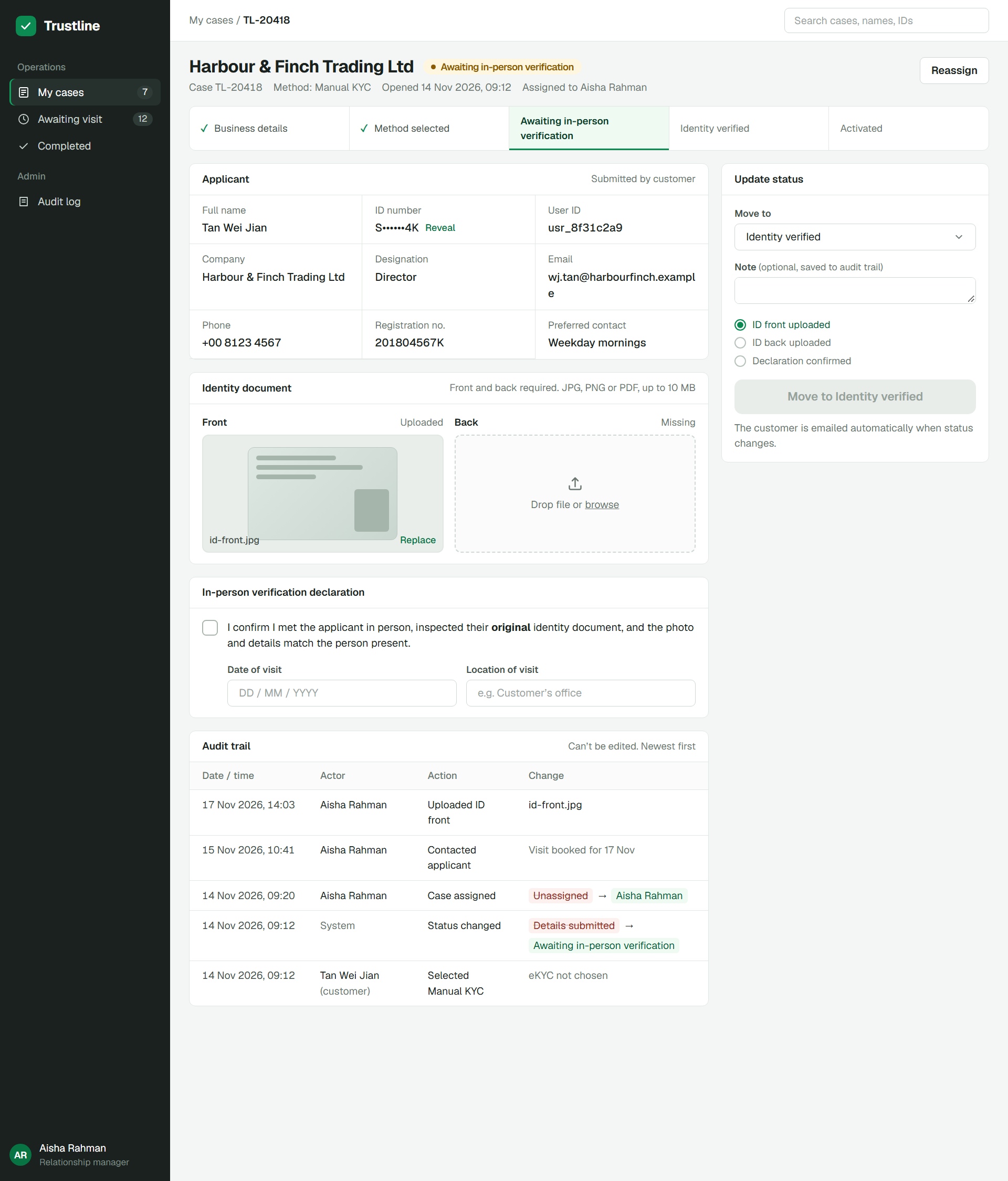
Overview screen: Set up credit checks for your business Identity verification screen with two equal options Relationship manager back-office case view

Summary

The onboarding journey sits on an existing business platform shared with several other services. The credit reporting flow inherited fields, requirements and assumptions that weren’t its own.

Businesses were dropping out, and the ones who stayed often didn’t understand why the process was asking what it was asking.

Borrowed complexity, unclear expectations

The flow was built on a platform that already served several other products. That meant convenience for engineering, and confusion for the business owner filling in the form. Three problems stood out.

Inherited fields that don’t belong

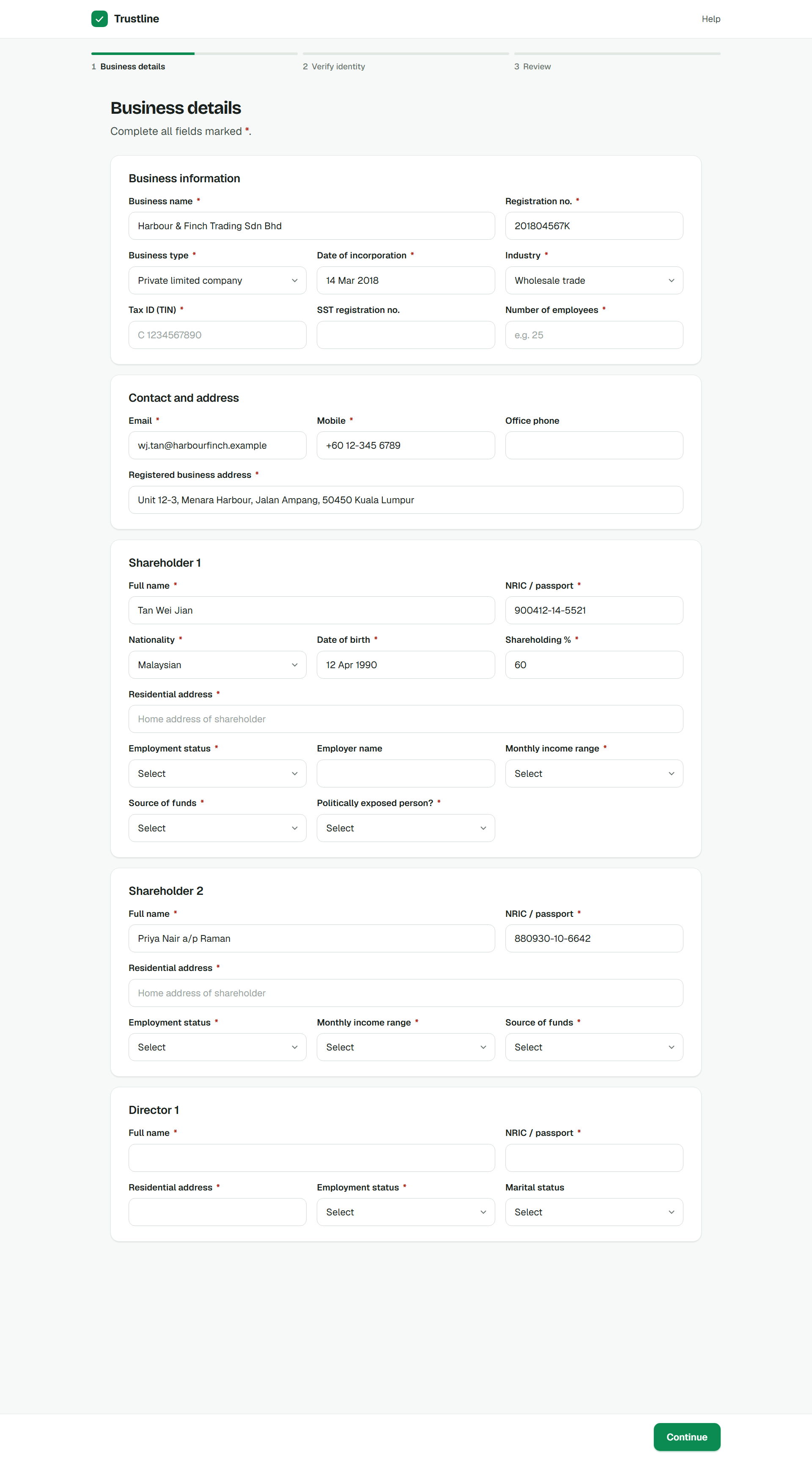
Onboarding was shared infrastructure, so SMEs were asked for details other services needed, like a shareholder’s residential address and employment status. The credit reporting agency had no requirement for them. Every unnecessary field is a reason to abandon the form.

The earlier form asking a shareholder for residential address, employment status and income

Before, reconstructed: fields the bureau never asked for.

eKYC as an unexplained wall

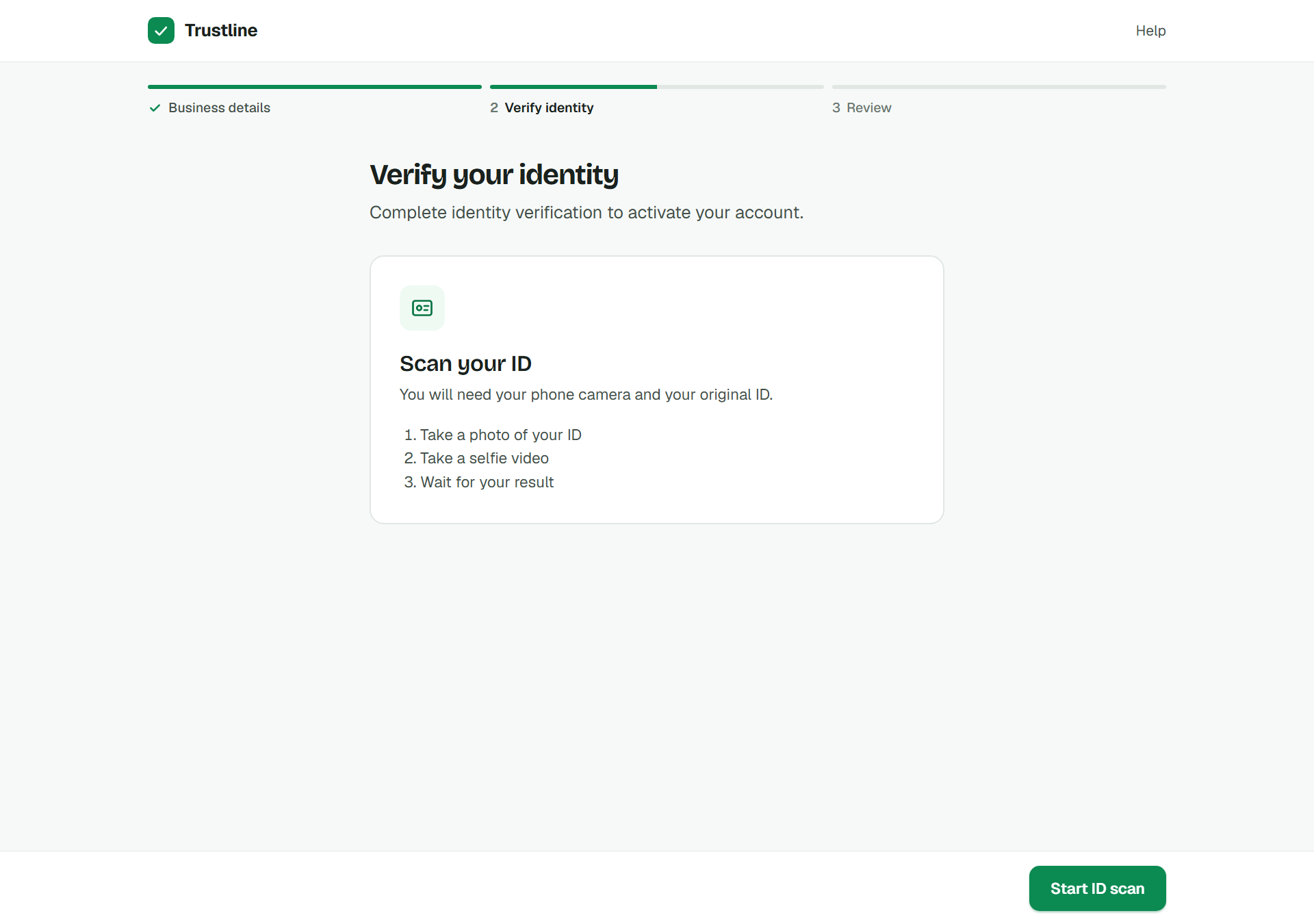
Business owners uneasy about submitting a live ID scan refused to complete eKYC, and there was no alternative. The business lost these customers outright. They wanted the service. The verification method didn’t fit how they were willing to operate.

The earlier identity page with a single option: scan your ID

Before, reconstructed: one way through, no way around.

Requirements discovered too late

Every application needs at least one director, owner or partner to sign up and verify their identity personally. Nobody said so up front. Some people assumed any staff member could onboard on the company’s behalf, then hit a wall midway, after investing time in business details.

Needs a director
Start the formFinish

The requirement appeared at the point of most effort already spent.

Design goals

Each problem became one rule for the redesign.

Ask only what’s needed

Strip the form down to what the credit reporting service requires, not what the shared platform’s other services happen to need.

Offer a way forward, not a wall

Give people uneasy about eKYC a legitimate alternative, rather than losing them at that step.

Set expectations before commitment

Say what’s required, and who in the business must complete it, before anyone invests time in the form.

Decision 01

Hiding what doesn’t belong

Audit every field against what the credit reporting agency actually requires, and hide the rest from the UI, even if the platform still supports it elsewhere.

Before: a shareholder11 fields
Shareholder card in the earlier form with eleven fields
After: a shareholder4 fields
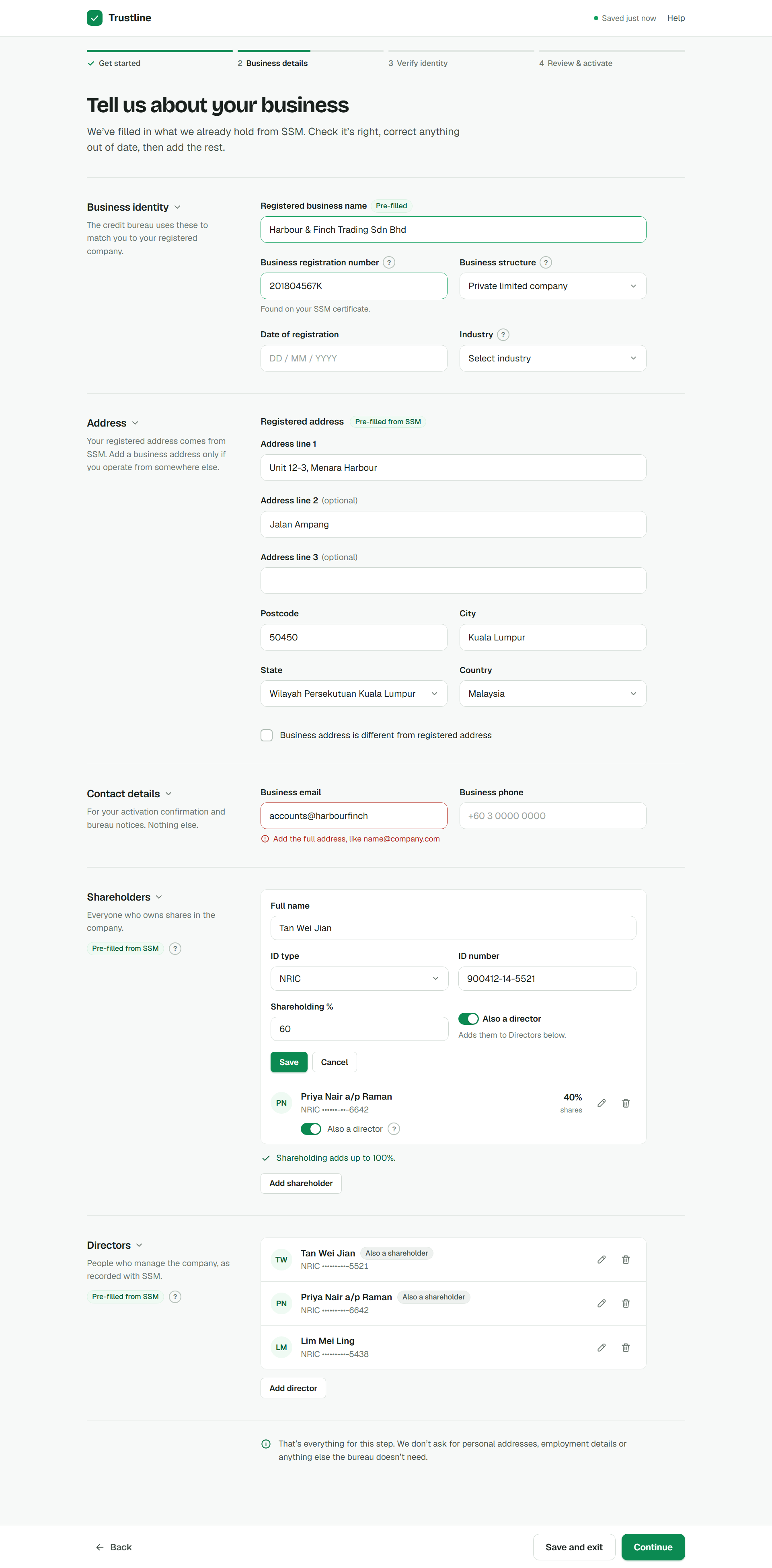
The redesigned shareholder form with four fields: full name, ID type, ID number and shareholding percentage 1 2 3 4

Full name, ID type, ID number and shareholding. Eight fields leave the screen, and one is added (ID type, so passports work too). The shareholder list arrives pre-filled from SSM where the data exists.

The problem

Onboarding inherited mandatory fields from other services on the same platform, fields the credit reporting agency had no requirement for.

The decision

Audit every field against the agency’s real requirements. Hide anything non-mandatory to this service from the UI, even where the platform still collects it elsewhere.

Why it mattered

A field you don’t understand is friction, and fields with no bearing on the service are the easiest to remove. It was a subtraction exercise, not a redesign: a low-risk, high-impact first move.

Decision 02

Manual KYC as a legitimate path, not a workaround

Refusing eKYC used to mean refusing the service. Now identity verification is a choice between two accepted methods, and the second one needed a new internal tool.

The problem

eKYC refusal was costing real, qualified customers. With no fallback, refusing the scan meant refusing the service entirely.

The decision

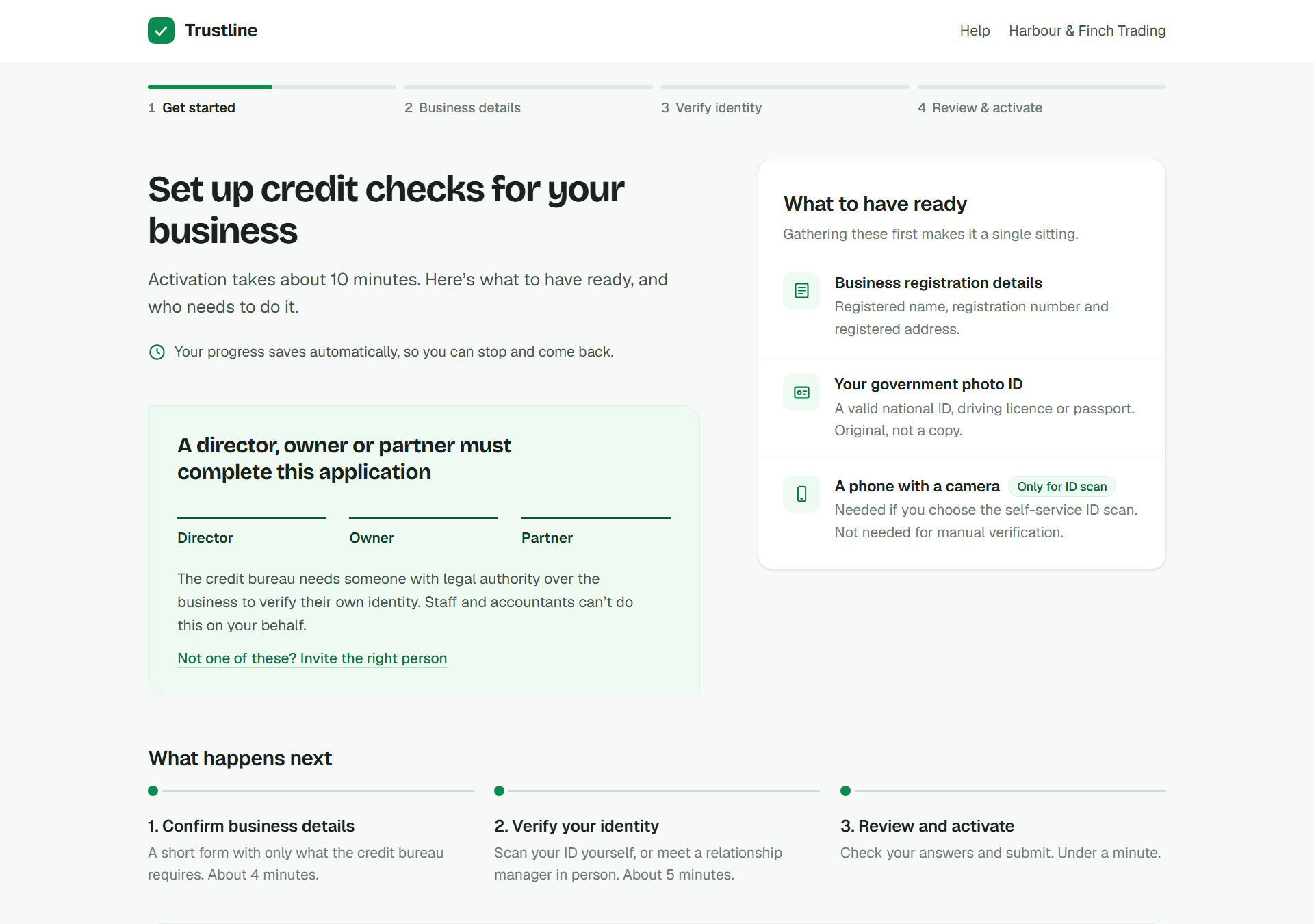
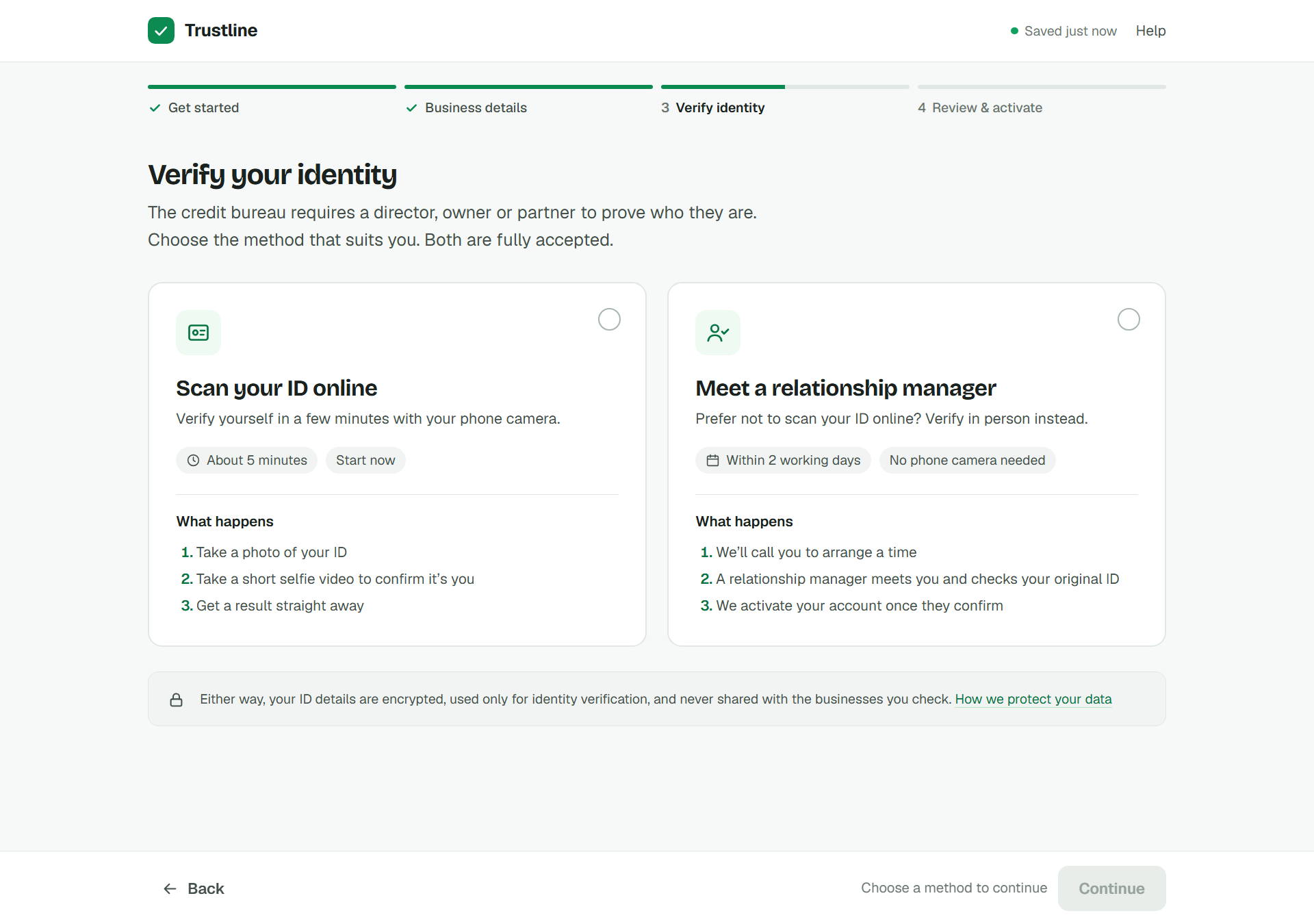
Add Manual KYC directly on the identity page as an equal option. It routes the application to Trustline’s relationship managers, who contact the customer and verify in person. They record the proof in a dedicated back-office portal and move the application forward.

Why it mattered

Identity verification becomes a spectrum of accepted methods rather than a single gate. It costs more operationally, since a manager’s time replaces a self-service scan, but it converts customers who would otherwise be lost outright.
AWhat the customer sees

Identity verification page with two options: Scan your ID online, and Meet a relationship managerSame page with Meet a relationship manager chosen and the button reading Request a call

BWhat the relationship manager sees

Relationship manager back-office case view for one application
Decision 03

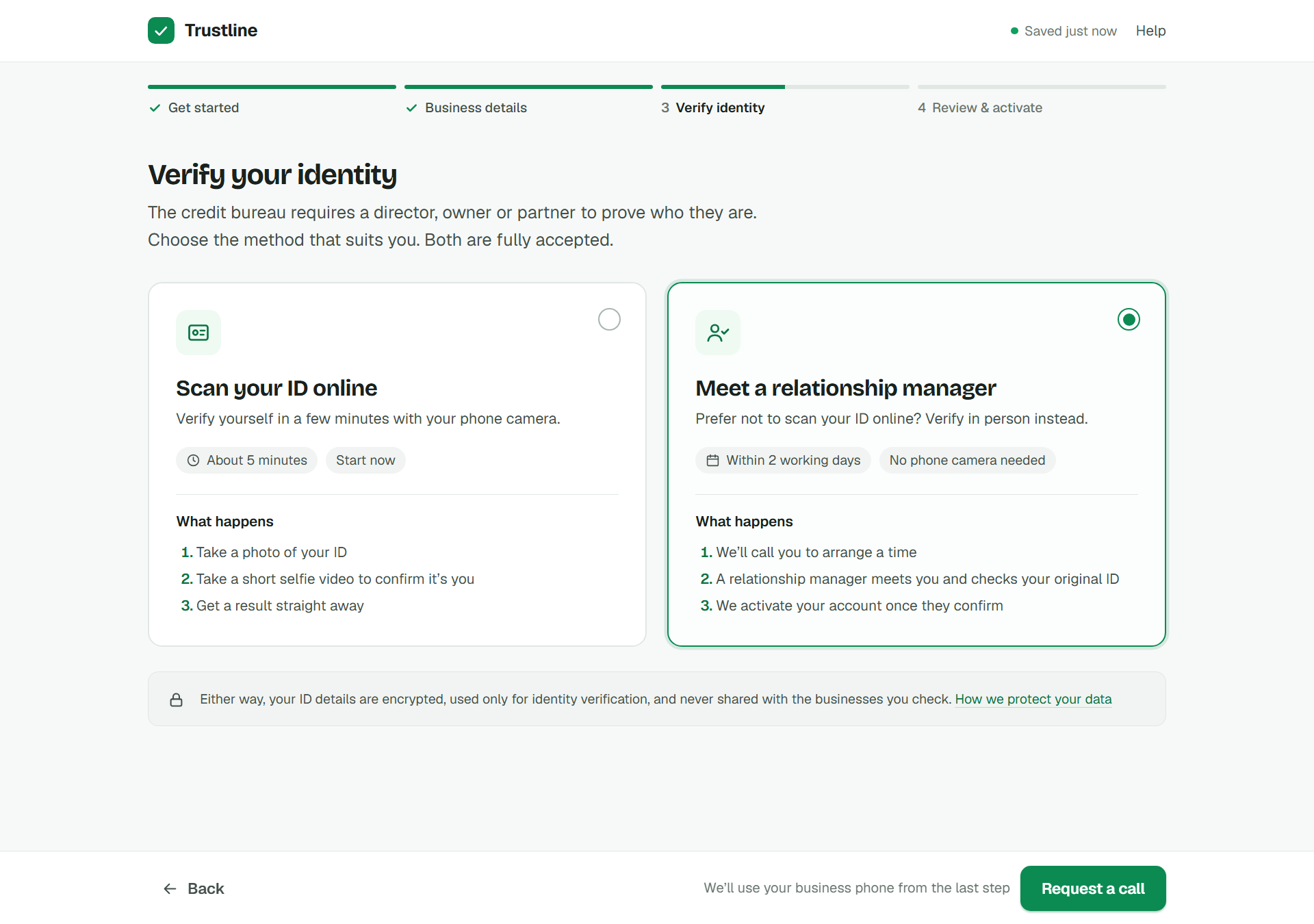
An overview page before the form starts

Move the moment of realisation from “midway, already invested” to “before starting, cheaply corrected.”

Overview page explaining what to have ready and who must complete the application
Needs a director
StartFinish

The problem

Requirements, like needing a director, owner or partner specifically, surfaced mid-journey. People felt their effort was wasted, especially if they weren’t the right person at all.

The decision

An overview page as the entry point, before any form fields. It sets out what to prepare and confirms who in the business is eligible to complete the process.

Why it mattered

Someone who isn’t the right person can hand it off immediately, instead of abandoning a half-filled form or completing it incorrectly.

Retrospective

Before and after, side by side. Drag the handle, or focus it and use the arrow keys.

After: identity page with Manual KYC as an equal option Before: identity page with only one option Before: eKYC or nothingAfter: two accepted methods

Measured impact

−17%

Total onboarding journey completion time.

Median completion time, before and after release.

Intended impact

  • Fewer drop-offs, by removing fields irrelevant to the service being activated.
  • Customers uneasy about eKYC stay in the journey through a manual, relationship-manager-led alternative.
  • Less mid-journey confusion and wasted effort, by setting expectations upfront, including who in the business must complete the process.
Linen colours
Brand identity